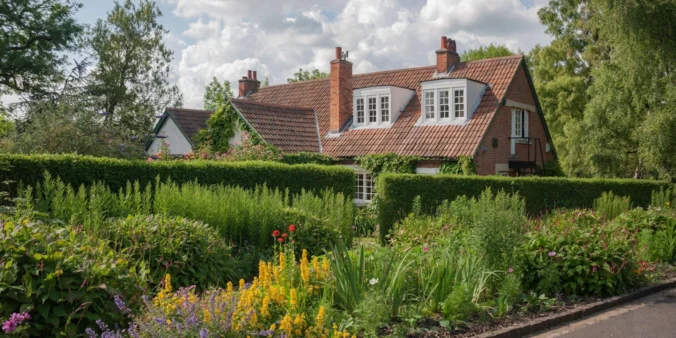
Learn more about C.S. Lewis and The Kilns in Oxford
Audio Tour
C.S. Lewis at The Kilns
The Kilns is C.S. Lewis’s home in the Oxford suburb of Headington Quarry from 11 October 1931 until his death on 22 November 1963. In June 1921, the twenty-two-year-old Lewis joins the household of Mrs Janie Moore (1872–1951). Mrs Moore is the mother of Paddy (1898–1918), a peer from Bristol, whom Lewis meets during his officer’s training at Keble College in Oxford in June 1917. In March 1918, Paddy Moore is killed in action at the Western Front in France. After the First World War, Lewis goes to live with Mrs Moore. Over the years, they live in several different rented homes. After the death of Father Albert Lewis in September 1929, it is decided that Lewis’s older brother Warren (1895–1973), who expects to retire from the British Army in 1932, would live with his younger brother and Mrs Moore in a house financed by the sale of Little Lea, Lewis’s childhood home in Belfast. Little Lea is sold in June 1930, but the money realised is less than expected, so additional money is provided through Mrs Moore from the Askins Trust Fund. The Lewis brothers first see The Kilns on 6 July 1930. The house is built in 1922 and has a garden, tennis court, large pond, greenhouse, and the remains of two big brick kilns, after which the house is named. It has four bedrooms, a kitchen, two reception rooms, a scullery, and a small maid’s bedroom. Mrs Moore buys the house with the settlement whereby it would be the Lewis brother’s home for the rest of their lives, after which it would pass to Mrs Moore’s daughter Maureen (1906–1997). On 11 October 1931, Lewis moves with Mrs Moore from Hillsboro House to The Kilns. The household includes one or two maids through the years, with Mrs Molly Miller (1901–1976) as a permanent housemaid for about 20 years from 1953. Mrs Moore lives at The Kilns until early 1950. In her declining years, she is often in pain. On 29 April 1950, she goes into Restholme, a nursing home in Oxford, where C.S. Lewis visits her nearly every day. Mrs Moore dies on 12 January 1951, at the age of 78. She is buried in the churchyard of Holy Trinity Church in Headington Quarry.
In 1930, Fred Paxford (1898-1979) comes to The Kilns as a gardener and handyman and lives there in a small bungalow until C.S. Lewis’s death in November 1963. Under Paxford’s guidance, the Lewis brothers and Mrs Moore make many improvements to the property. They plant an orchard, add fish to the flooded clay pit, and build fences, walking paths, and a concrete bunker during the Second World War. In 1932, two rooms are added for Warren on his retirement and return from military service in China. They extend from the back of the left side of the house with a study and a bedroom. When Maureen Moore moves out after her marriage in August 1940, Warren moves his bedroom upstairs to Maureen’s room. Lewis finds The Kilns a delightful and idyllic place to live, and he loves walking in the woods, especially during seasonal changes. Over the years, he often invites friends, students, and colleagues to visit. The nature surrounding The Kilns provides much of the inspiration for the scenery in Lewis’s Narnia stories. Much of the house’s original garden is now part of the freely accessible C.S. Lewis Nature Reserve.
After the Second World War outbreak on 1 September 1939, many children are evacuated from London to Oxford. C.S. Lewis and Mrs Moore welcome the first of the many evacuated children to live at The Kilns for the next few years. Because of his work at Oxford University, Lewis is not called up for service in the British Army. In the summer of 1940, he joins the Oxford City Home Guard Battalion as a volunteer.
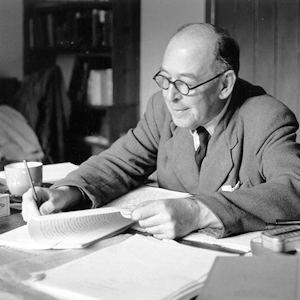
BBC
Due to his increasing fame as a Christian writer and apologist following the publication of his book The Problem of Pain in October 1940, C.S. Lewis is asked by the director of the British Broadcasting Corporation’s Religious Department in February 1941 to give a series of fifteen-minute talks on the BBC. Lewis agrees, and every Wednesday in August, he goes to London to give four live talks on natural law as an implicit background to the Christian Scriptures. The series, entitled ‘Right and Wrong: A Clue to the Meaning of the Universe’, is a great success. On 6 September, Lewis returns to the microphone to give a talk to answer some listeners’ questions. His radio talks prove so successful that he is persuaded to return for three more series. In January and February 1942, Lewis gives five talks, under the title ‘What Christians Believe’, on what all Christians, regardless of denomination, believe. In July 1942, the two series of radio talks are published in one volume as Broadcast Talks, and it immediately becomes a bestseller.
Following the success of the previous broadcasts, C.S. Lewis gives eight radio talks on Christian behaviour from September to November 1942. He devotes most of his time to the Christian virtues of faith, hope, charity, and forgiveness. Lewis gives positive and practical advice grounded in his own life experience. In April 1943, the series is published in the book Christian Behaviour. A Further Series of Broadcast Talks.
From February to April 1944, C.S. Lewis gives his final series of seven recorded radio talks, entitled ‘Beyond Personality: The Christian View of God’. Only talk seven of the series has survived in the archives of the BBC. Lewis’s last series appears in The Listener, the BBC’s own periodical, and is published in weekly instalments between 24 February and 6 April. In October 1944, the talks are published as Beyond Personality. The Christian Idea of God. Finally, the four series of radio talks are combined into a single volume and published in July 1952 as Mere Christianity, a title Lewis borrows from the English Puritan theologian Richard Baxter (1615–1691).
Royal Air Force
In the winter of 1941, before his BBC radio talks, C.S. Lewis is asked to give talks on theology to members of the Royal Air Force. He gives the first in May 1941 at the RAF base in Abingdon. It seems to be unsuccessful for him, but the success of his subsequent radio talks over the BBC is such that the RAF chaplain-in-chief invites Lewis to speak at RAF stations all over the country. Wanting to aid the war effort, Lewis agrees, and all through the summer of 1942, he travels to far and remote places, away from home for two or three days at a time. This takes a toll on his health, but Lewis feels it is his duty to do so, which he does until the end of the Second World War in 1945. Lewis gives the fees from the RAF and BBC for his talks to a fund for clergy widows. With the help of his friend Owen Barfield (1898–1997), he sets up a charity trust, the Agape Fund. Lewis has most of his royalties paid in the fund for supplying anonymous gifts of money to various people in need.
The Great Divorce
Around August 1931, C.S. Lewis encounters an old idea of the refrigerium: the idea that the perishing souls in hell may sometimes have remission and refreshment. An idea for a religious book about a holiday from hell arises in Lewis. It first appears in fourteen instalments in the Church of England weekly newspaper, The Guardian, from 10 November 1944 to 13 April 1945. In November, it is published as The Great Divorce. The book is a dream vision about some residents of hell going on holiday to heaven. If they prefer heaven over hell, they are free to remain, but on the condition that they give up some vice that hinders them from experiencing real joy. However, nearly none of them decide to stay because they have to give up too much. According to Lewis, any natural impulse, no matter how virtuous, becomes destructive if regarded as the sole absolute. Pride is the most deadly of the sins because it locks the sinner into an attitude of refusal of the joys of heaven. For Lewis, there are two kinds of people in the end: those who say to God, ‘Thy will be done’ and those to whom God says, ‘thy will be done’. Without that self-choice, there can be no hell. No one who earnestly and constantly longs for joy will ever miss it. It is between those who do and those who do not, and between heaven and hell, that the great divorce exists.
Joy
On 10 January 1950, C.S. Lewis receives the first letter from an American woman, Joy Davidman Gresham (1915–1960), and they begin to correspond. On 24 September 1952, Lewis meets Joy for the first time to have lunch at the Eastgate Hotel in Oxford, when she spends about five months in England. A friendship begins, and Lewis invites Joy to The Kilns, where she spends two weeks. At Christmas 1952, Joy stays at The Kilns for another two weeks. Towards the end of her stay, she receives a letter from her husband, Bill Gresham. He asks her for a divorce. Joy goes home in January 1953, but in November, she returns to England with her sons David and Douglas and takes rooms in London. Eventually, Joy and Bill divorce on 5 August 1954.
In August 1955, Joy rents 10 Old High Street in Oxford, about one mile from C.S. Lewis’s home, The Kilns. Lewis starts visiting Joy and her sons every day now. For unknown reasons, Joy cannot have her visa renewed in 1956. The British Home Office refuses Joy permission to live and work in England, but Lewis would rather not see her return to America. The only solution he can think of is for them to go through a civil marriage ceremony. Regarding such a legal form as totally different from a true marriage, Lewis is following the teaching of the Anglican Church. The civil ceremony does not make them man and wife, and Lewis will continue to live in his house while Joy will live in hers. On 23 April 1956, when he is 57 years old, Lewis marries Joy in a private civil ceremony in a Register Office at 42 St Giles’ in Oxford. This gives Joy the right to British citizenship, and the patrial status entitles David and Douglas to claim British nationality. After the ceremony, Joy keeps her own name and home at Old High Street.
Although she is only 41, Joy begins suffering from pains in her leg, back, and chest in 1956. Following a fall on 18 October, she is discovered to have cancer in her leg, breast, and shoulder. She is admitted to the Wingfield-Morris Hospital in Oxford. Her prognosis is grim, and the doctors believe her to be dying. Joy’s illness and suffering make C.S. Lewis aware of his love for her. He wants to take her home to The Kilns but first seeks to be married by the church. In line with the Catholic Church’s position on marriage, Lewis believes he may marry Joy because her marriage to Bill Gresham was invalid since Bill’s first wife, whom he divorced, was still alive when he married Joy. However, the Bishop of Oxford, Harry Carpenter (1901–1993), says that the official Church of England’s position is otherwise. He refuses to permit any of the priests in the Diocese of Oxford to marry Lewis and Joy.
To comfort Joy in her pain, C.S. Lewis asks his friend and former student, Rev Peter Bide (1912–2003), from the Diocese of Chichester, to come. As a hospital Chaplain, Bide faced a terrible polio epidemic in his area in 1954. When he prayed for a seriously ill boy who seemed to be dying, the boy healed miraculously. Therefore, Lewis asks Bide to come and lay hands on Joy and pray for her. Lewis and Bide discuss the impediments to a Christian marriage, and they agree that it would be right to conduct a church ceremony before Joy dies. Bide promises to perform it the day after he prays for Joy’s recovery. On 21 March 1957, C.S. Lewis and Joy Davidman are married by Rev Peter Bide in a ceremony in the Wingfield-Morris Hospital’s Mayfair Suite. Much to the astonishment of her doctors, Joy regains strength after Bide prays for her. In April 1957, she is discharged from hospital, and moves into The Kilns, where she makes many improvements to the house.
Till We Have Faces. A Myth Retold
In September 1956, C.S. Lewis publishes Till We Have Faces. A Myth Retold. This book is his last work of fiction and is dedicated to Joy. It is Lewis’s final attempt to retell the classical Greek myth of Cupid and Psyche, as found in the Metamorphoses of the Numidian writer and philosopher Apuleius (125–170). Lewis struggles with it from the time he is a student at Oxford University during the 1920s. His first attempt is to retell the story in verse. In the spring of 1955, Lewis understands, with the help of Joy, what he wants to say, and the final version is written in prose. After discussing the book with Joy as it is being written, she edits and types it. In retelling the story, Lewis introduces a new character as the narrator: Orual, the queen of Glome and the ugly sister of Psyche. Although she is passionate and longs to love and to be loved, her jealousy and possessiveness preclude it. The book tells the story of how she is redeemed.
Reflections on the Psalms
Following his conversion to a belief in God in June 1930, C.S. Lewis begins to attend Holy Trinity Church and the daily services at the chapel of Magdalen College in Oxford. By constantly reading and praying the Psalms on his own and through the offices of the Morning and Evening Prayer, Lewis knows the Psalms almost by heart. Because he doesn’t read Hebrew, the original language in which the Psalms are written, Lewis uses the translation of the Psalms found in the Book of Common Prayer. At the suggestion of his friend, the philosopher and theologian Austin Farrer (1904–1968), Lewis writes a book on the Psalms. Joy strongly supports him and offers to edit and type the manuscript. They discuss much of the book’s content during the summer vacation of 1957. According to Lewis, the book is not a work of scholarship, but he writes as an amateur to another, discussing the difficulties he has encountered or the insights he has gained while reading the Psalms. He hopes that this might interest and sometimes even help other inexpert readers. The book Reflections on the Psalms is published in September 1958. Shortly afterwards, Lewis receives a letter from the Archbishop of Canterbury, Geoffrey Fisher (1887–1972), inviting him to join the Commission to Revise the Psalter, as it appears in the Book of Common Prayer.
› Buy Reflections on the Psalms
The Four Loves
In January 1958, C.S. Lewis receives a request from the Episcopal Radio-TV Foundation of Atlanta to make some tape recordings to be played over the air. After discussions with Joy, Lewis agrees. He decides to talk about Christian ethics using the four Greek words storge, philia, eros, and agape, meaning affection, friendship, eros, and charity. Lewis finishes the scripts in the summer of 1958, which are recorded on 19–20 August in London. An hour is devoted to each of the four kinds of love. The recordings are later heard over various radio stations in the United States. In his talks, Lewis distinguishes between gift love and need love. God is pure gift love, and our being is one vast need in relation to God. Whether as gift-love or need-love, every natural love left to itself cannot be what it naturally seeks to be. Lewis characterises each of the four loves, exhibiting features that offer at least a mirror of divine love. He then notes the dangers inherent in natural love’s insufficiency that usually manifest themselves when love is at its best. He suggests that something more is needed for love to be itself truly. Lewis retains the rights to turn the recordings into a book, which he does by midsummer 1959. In March 1960, it is published as The Four Loves.
Loss
A routine examination on 13 October 1959 reveals that cancerous spots are returning to many of Joy’s bones. Even with medication and radiation therapy, her prospects are not good. Despite Joy’s serious condition, the Lewises go on holiday to Greece in April 1960, a trip they have both long looked forward to. But Joy is not doing well, and after returning from Greece, she has to go to the hospital often. Joy’s health grows progressively worse, and on 13 July 1960, she dies at the age of 45 at Radcliffe Infirmary in Oxford. On 18 July, her funeral takes place at the Oxford Crematorium. A marble plaque on the garden wall near where her ashes are scattered bears a poem written by C.S. Lewis.
A Grief Observed
In the days following the death of Joy in July 1960, C.S. Lewis writes A Grief Observed. It is a short book as an examination of the grief he suffers due to the loss of his wife and its effect on him and his thinking. Lewis has lost Joy, and with her, all of his creativity. He can no longer think, write, or pray. He has no words and can only repeat the conventional prayers everybody knows. This impedes his spirituality, and so Lewis begins a close study of his grief, what it is like and how it works in him. His intense search for understanding helps him control his grief. He discovers that Joy is more real to him now than in life. A Grief Observed is published in September 1961 under the pseudonym N.W. Clerk. N.W. stands for Nat Whilk, Anglo-Saxon for ‘I know not who’, that is, anonymous. The only person, besides Lewis’s publisher, who is told of the book’s existence is his friend Roger Lancelyn Green (1918–1987). A Grief Observed does not sell well until it is reissued posthumously under Lewis’s own name in 1964.
Letters to Malcolm: Chiefly on Prayer
C.S. Lewis has been trying to write about prayer since 1952, but the idea has not taken off. In December 1952, he begins writing a book on it and works on it in 1953, but he gives it up early in 1954. Lewis knows he has not found the right form for what he has to say about prayer until the idea comes to him of an imaginary correspondence between himself and a fictitious friend called ‘Malcolm’ in the spring of 1963. It occurs to Lewis that he might use once again the semi-fictional method of his earlier books, The Screwtape Letters and The Great Divorce. In this form, the book’s ideas about prayer and the Christian life are not conveyed as concepts but embedded in the events and activities of personal life stories. In March and April 1963, about six months before his death, Lewis writes twenty-two letters to the imaginary correspondence on prayer. His last book, Letters to Malcolm: Chiefly on Prayer, is published posthumously in January 1964.
Letters
From his first broadcasts over the BBC in August 1941, C.S. Lewis is inundated with letters. As he gains more readers, the pile of letters grows larger, especially after the publication of his books The Screwtape Letters and Miracles in America in February 1943 and September 1947. The 8 September 1947 issue of Time Magazine features Lewis on its cover, with an article inside about C.S. Lewis as one of the growing band of intellectuals who came to believe in God. As a result, Lewis receives a great many letters and parcels with gifts from American admirers. Many gifts are shared with others outside The Kilns. Answering all the letters would have been impossible without the help of Lewis’s brother, Warren. In the afternoon of 7 June 1962, Lewis gives tea to a young man from North Carolina, Walter Hooper (1931–2020), who is teaching at the University of Kentucky. They have been corresponding since 1954. During the following weeks, Lewis meets Hooper a lot at The Kilns, and he takes him along to the meeting of the Inklings. Lewis asks Hooper to be his personal secretary because there are hundreds of letters to respond to. After Lewis’s death, Hooper becomes a biographer of Lewis and the collector and editor of his writings. Lewis’s correspondence is published between 2000 and 2007 in the three volumes of C.S. Lewis. Collected Letters, edited by Walter Hooper.
Death
In June 1961, C.S. Lewis becomes ill and is diagnosed with a seriously enlarged prostate. An operation is set for Sunday 2 July, but in the end, the surgeon decides it is too dangerous to operate. While waiting for the doctors to decide whether or not to operate, Lewis is not well enough to return to work in Cambridge. When an operation proves impossible, he begins a long series of blood transfusions every few weeks at the Acland Nursing Home in Oxford. He gradually improves and returns to Cambridge in April 1962, but he feels his health will not improve enough to undergo the vital surgery.
In late June 1963, C.S. Lewis feels very weak and needs long periods of rest because he suffers from kidney failure. When admitted to the Acland Nursing Home for an examination, he suffers a heart attack on 16 July and falls into a coma. The doctors think he is dying, but the next afternoon, he awakes from his coma. Over the next two weeks at the hospital, Lewis improves and sees many visitors. When he returns from the hospital with a nurse at home on 6 August, he realises that he is unable to return to work in Cambridge. Not expecting to live long, he writes a letter of resignation to Cambridge University in August 1963. On 14 August, Lewis sends Walter Hooper, with David and Douglas Gresham, to Cambridge to clear his rooms and sort out his books and papers.
In the autumn of 1963, Ronald Head (1919–1991), the Vicar of Holy Trinity Church and a close friend of C.S. Lewis and his brother Warren, comes twice a week to The Kilns to give Lewis communion, and he has visits from many old friends. On 22 November 1963, a few days before his birthday, Lewis dies at the age of 64. The day begins much like any other day. After lunch, Lewis falls asleep in his chair. His brother Warren suggests he would be more comfortable in bed, and Lewis goes there. At four o’clock, Warren takes him his tea and finds him drowsy but comfortable. At five-thirty, Warren hears a crash and runs in to find his brother lying unconscious at the foot of his bed. A few minutes later, Lewis stops breathing.
Funeral
C.S. Lewis’s funeral is hold at Holy Trinity Church on 26 November. A few close personal friends attend it. Magdalen College and the University of Oxford are also represented. Many of Lewis’s friends fail to hear of his death in time because US President John F. Kennedy also died on 22 November, and the newspapers are mainly given over to him. On 7 December 1963, a memorial service for C.S. Lewis is hold in the chapel of Magdalen College.
Study Centre
After C.S. Lewis’s death, his brother Warren moves away from The Kilns for three years and then returns to live there until his death in April 1973. After Lewis’s death, the brick kilns, sheds, and Fred Paxford’s bungalow are demolished. In 1968, some houses are built on The Kilns’s grounds. Free and clear title to the house and estates passes to Maureen Moore after the death of Warren in 1973. In 1984, The Kilns is acquired by the C.S. Lewis Foundation of Redlands, California. The Kilns is now owned and operated by the foundation, which runs it as the C.S. Lewis Study Centre and a residential home for scholars. Tours of The Kilns are conducted by appointment.
Dedication
After C.S. Lewis’s death, many of his popular books are reprinted, and collections of essays are published. A documentary, stage play and two films about his life were published in the 1970s, 1980s and 1990s. On Friday 22 November 2013, fifty years after his death, C.S. Lewis is commemorated with a memorial floor stone in Poets’ Corner, a section of the southern transept of Westminster Abbey in London, where many poets, playwrights, and writers who have contributed to British culture are buried or commemorated. On the memorial stone is a quotation from a paper given by Lewis to the Socratic Club, entitled ‘Is Theology Poetry?’. It reads: I believe in Christianity as I believe that the sun has risen, not only because I see it but because by it I see everything else. The dedication service includes a reading from Lewis’s book The Last Battle by his younger stepson, Douglas Gresham. An address is delivered by former Archbishop of Canterbury Rowan Williams. Flowers were laid by Walter Hooper, former secretary and biographer of Lewis and collector and editor of his writings.
Sources
Walter Hooper, C.S. Lewis. Companion & Guide
Simon Horobin, C.S. Lewis’s Oxford
Jeffrey Schultz & John West, The C.S. Lewis Readers’ Encyclopedia
Photo by Martin Anderson